
Hyundai Tucson: Engine Control System / CVVT Oil Control Valve (OCV) Repair procedures
Hyundai Tucson (LM) 2010-2015 Service Manual / Engine Control / Fuel System / Engine Control System / CVVT Oil Control Valve (OCV) Repair procedures
| Inspection |
| 1. |
Turn the ignition switch OFF. |
| 2. |
Disconnect the OCV connector. |
| 3. |
Measure resistance between the OCV terminals 1 and 2. |
| 4. |
Check that the resistance is within the specification.
|
| Removal |
| 1. |
Turn the ignition switch OFF and disconnect the battery negative (-) cable. |
| 2. |
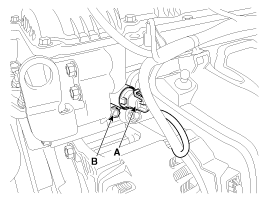
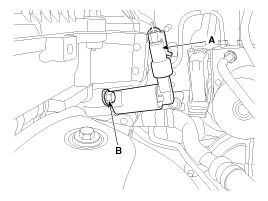
Disconnect the CVVT oil control valve connector (A). |
| 3. |
Remove the installation bolt (B), and then remove the valve from the engine.
[Bank 1 / Intake]
[Bank 1 / Exhaust]
|
| Installation |
|

|
| 1. |
Install in the reverse order of removal.
|
 CVVT Oil Control Valve (OCV) Schematic Diagrams
Circuit Diagram
(M/T)
(A/T)
...
 Variable Intake Solenoid (VIS) Valve Description and Operation
Description
Variable Intake manifold Solenoid (VIS) valve is installed on
the intake manifold. The VIS valve controls the vacuum modulator which
activates a valve in the intake manifold. The EC ...
Other information:
Hyundai Tucson (LM) 2010-2015 Service Manual: Direct Electro Hydraulic Actuator Coupling Components and Components Location
Component Location
1. Transaxle Assembly2. Transfer assembly3. Propeller shaft4. Coupling assembly
Components
1. Coupling assembly2. Input shaft3. Pressure sensor4. Extension wiring5. Oil hydraulic Motor(Actuator)
...
Hyundai Tucson (LM) 2010-2015 Owners Manual: Owner maintenance
WARNING
Performing maintenance work on a vehicle can be dangerous. If you lack sufficient
knowledge and experience or the proper tools and equipment to do the work, have
it done by an authorized HYUNDAI dealer. ALWAYS follow these precautions for performing
maintenance work:
Park your veh ...
© 2010-2026 www.htmanual.net
