
Hyundai Tucson: What to do in an emergency / If the engine overheats
If your temperature gauge indicates overheating, you experience a loss of power, or hear loud pinging or knocking, the engine may be overheating.
If this happens, you should:
1.Pull off the road and stop as soon as it is safe to do so.
2.Place the shift lever in P (Park) and set the parking brake. If the air conditioning is ON, turn it OFF.
3.If engine coolant is running out under the vehicle or steam is coming out from the hood, stop the engine. Do not open the hood until the coolant has stopped running or the steaming has stopped. If there is no visible loss of engine coolant and no steam, leave the engine running and check to be sure the engine cooling fan is operating. If the fan is not running, turn the engine off.
WARNING
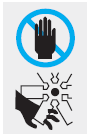
While the engine is running, keep hands, clothing and tools away from the moving parts such as the cooling fan and drive belt to prevent serious injury.
4.Check for coolant leaking from the radiator, hoses or under the vehicle.
(If the air conditioning had been in use, it is normal for cold water to be draining from it when you stop.)
5.If engine coolant is leaking out, stop the engine immediately and call the nearest authorized HYUNDAI dealer for assistance.
WARNING

NEVER remove the radiator cap or the drain plug while the engine and radiator are hot. Hot coolant and steam may blow out under pressure, causing serious injury. Turn the engine off and wait until the engine cools down. Use extreme care when removing the radiator cap. Wrap a thick towel around it, and turn it counterclockwise slowly to the first stop. Step back while the pressure is released from the cooling system. When you are sure all the pressure has been released, press down on the cap, using a thick towel, and continue turning counterclockwise to remove it.
6.If you cannot find the cause of the overheating, wait until the engine temperature has returned to normal. Then, if coolant has been lost, carefully add coolant to the reservoir to bring the fluid level in the reservoir up to the halfway mark.
7.Proceed with caution, keeping alert for further signs of overheating. If overheating happens again, call an authorized HYUNDAI dealer for assistance.
CAUTION
Serious loss of coolant indicates a leak in the cooling system and should be checked as soon as possible by an authorized HYUNDAI dealer.
 Jump starting
Jump starting can be dangerous if done incorrectly. Follow the jump starting
procedure in this section to avoid serious injury or damage to your vehicle. If
in doubt about how to properly jump sta ...
 Tire pressure monitoring system (TPMS)
(1) Low Tire Pressure Telltale/ TPMS Malfunction Indicator
WARNING
Over-inflation or under-inflation can reduce tire life, adversely affect vehicle
handling, and lead to sudden tire failure th ...
Other information:
Hyundai Tucson (LM) 2010-2015 Service Manual: Hazard Lamp Switch Repair procedures
Removal
1.
Disconnect the negative (-) battery terminal.
2.
Remove the hazard lamp switch assembly.
(Refer to the BE group - "Audio head unit")
3.
Disconnect the hazard lamp switch connector (A).
4.
If the hazard lamp switch is not as specified, replace it carefully and take care n ...
Hyundai Tucson (LM) 2010-2015 Service Manual: License Lamps Repair procedures
Removal
1.
Disconnect the negative (-) battery terminal.
2.
Remove the license lamp lens (B) by pressing the clip (A).
3.
Turn the license bulb socket (A) counterclockwise to remove the bulb (B) from lens (C).
Installation
1.
Install the bulb.
2.
Install the license lamp lens. ...
