
Hyundai Tucson: Automatic Transaxle Control System / Transaxle Control Module (TCM) Repair procedures
Hyundai Tucson (LM) 2010-2015 Service Manual / Automatic Transaxle System / Automatic Transaxle Control System / Transaxle Control Module (TCM) Repair procedures
| Replacement |
| 1. |
Turn ignition switch OFF. |
| 2. |
Disconnect the negative (-) battery cable. |
| 3. |
Remove the battery.
(Refer to Engine Electrical System - "Battery") |
| 4. |
Disconnect the TCM extension connector (A).
|
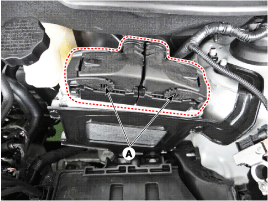
| 5. |
Remove the TCM (A) after removing the mounting bolts and nut.
|
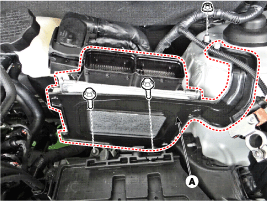
| Inspection |
TCM Problem Inspection Procedure
| 1. |
TEST TCM GROUND CIRCUIT: Measure resistance between TCM and
chassis ground using the backside of TCM harness connector as TCM side
check point. If the problem is found, repair it.
|
| 2. |
TEST TCM CONNECTOR: Disconnect the TCM connector and visually
check the ground terminals on TCM side and harness side for bent pins
or poor contact pressure. If the problem is found, repair it. |
| 3. |
If problem is not found in Step 1 and 2, the TCM could be
faulty. If so, make sure there were no DTC's before swapping the TCM
with a new one, and then check the vehicle again. If DTC's were found,
examine this first before swapping TCM. |
| 4. |
RE-TEST THE ORIGINAL TCM: Install the original TCM (may be
broken) into a known-good vehicle and check the vehicle. If the problem
occurs again, replace the original TCM with a new one. If problem does
not occur, this is intermittent problem (Refer to “Intermittent
Problem Inspection Procedure� in Basic Inspection Procedure).
|
| Installation |
| 1. |
Install in the reverse order of removal.
|

 Transaxle Control Module (TCM) Schematic Diagrams
1. TCM Connector and Terminal Function
2. TCM Terminal Function
Connector [A]
PinDescriptionPinDescription1-54-2-55-3-56-4-57-5-58Sport mode down switch6-59Oil temperature sensor (+)7-60-8-61-9-6 ...
 Transaxle Oil Temperature Sensor Description and Operation
Description
Transmission Oil Temperature Sensor monitors the automatic
transmission fluid's temperature and conveys the readings to TCM. It is
an NTC (Negative Thermal Coefficient) sensor whose ...
Other information:
Hyundai Tucson (LM) 2010-2015 Service Manual: Pressure Sensor Description and Operation
Description
The 4WD ECU makes a Motor Pump(Actuator) turn round for
generating an oil pressure. And then it presses a multiple disk clutch
and transfers the generated torque into rear wheels. Its torque value
varies according to a pressure status. ...
Hyundai Tucson (LM) 2010-2015 Service Manual: Starter Specifications
Specification
ItemSpecificationRated voltage12 V, 1.2 kWThe number of pinion teeth13Performance[No-load, 11 V]AmpereMax. 70 ASpeedMin. 2,400 rpm
...
© 2010-2026 www.htmanual.net
