
Hyundai Tucson: Brake System / Brake Line Repair procedures
| Removal |
| 1. |
Disconnect the brake fiuid level switch connector, and remove the reservoir cap. |
| 2. |
Remove the brake fluid from the master cylinder reservior with a syringe.
|

| 3. |
Remove the wheel & tire. |
| 4. |
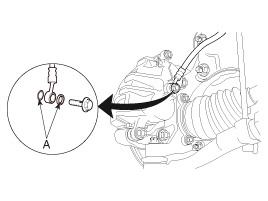
Remove the brake hose clip (A).
[Front]
[Rear]
|
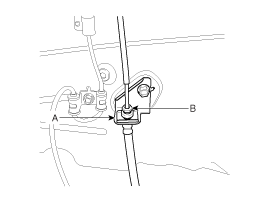
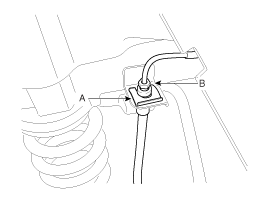
| 5. |
Disconnect the brake tube by loosening the tube flare nut (B).
|
| 6. |
Disconnect the brake hose from the brake caliper by loosening the bolt (C).
[Front]
[Rear]
|
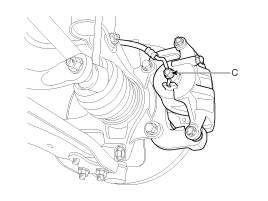
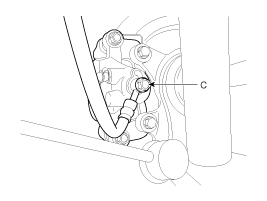
| Inspection |
| 1. |
Check the brake tubes for cracks, crimps and corrosion. |
| 2. |
Check the brake hoses for cracks, damage and fluid leakage. |
| 3. |
Check the brake tube flare nuts for damage and fluid leakage. |
| 4. |
Check brake hose mounting bracket for crack or deformation. |
| Installation |
| 1. |
Installation is the reverse of removal.
|
| 2. |
After installation, bleed the brake system.
(Refer to Brake system bleeding) |
| 3. |
Check the spilled brake oil. |
 Brake Line Components and Components Location
Components
...
 Brake Pedal Components and Components Location
Components
1. Cowl bracket2. Brake pedal member assembly3. Stop lamp switch4. Return spring5. Brake pedal stopper6. Clevis pin7. Snap pin8. Brake pedal
...
Other information:
Hyundai Tucson (LM) 2010-2015 Owners Manual: Scheduled maintenance services
Follow Normal Maintenance Schedule if the vehicle is usually operated where none
of the following conditions apply. If any of the following conditions apply, you
must follow the Maintenance Under Severe Usage Conditions.
Repeated short distance driving.
Driving in dusty conditions or sandy ...
Hyundai Tucson (LM) 2010-2015 Service Manual: Purge Control Solenoid Valve (PCSV) Description and Operation
Description
Purge Control Solenoid Valve (PCSV) is installed on the surge
tank and controls the passage between the canister and the intake
manifold. It is a solenoid valve and is open when the ECM grounds the
valve control line. When the passage is open (PCSV ON), fuel vapor
stored in th ...
