
Hyundai Tucson: Fuel Delivery System / Fuel Tank Repair procedures
| Removal |
| 1. |
Release the residual pressure in fuel line.
(Refer to Fuel Delivery System - "Release Residual Pressure in Fuel Line") |
| 2. |
Remove the rear seat cushion.
(Refer to Body - “Seat�) |
| 3. |
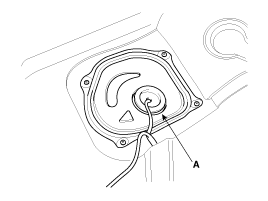
Remove the fuel pump service cover (A).
|
| 4. |
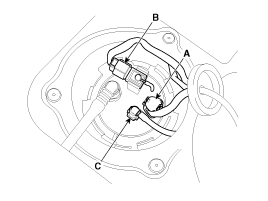
Disconnect the fuel pump connector (A) and the fuel tank pressure sensor connector (B). |
| 5. |
Disconnect the fuel feed tube quick connector (C).
|
| 6. |
Remove the rear - LH wheel & tire. |
| 7. |
Lift the vehicle and support the fuel tank with a jack. |
| 8. |
Remove the center muffler assembly.
(Refer to Engine Mechanical System - “Intake And Exhaust System�) |
| 9. |
Remove the propeller shaft.
(Refer to Driveshaft and Axle - “Propeller Shaft Assembly�) [4WD] |
| 10. |
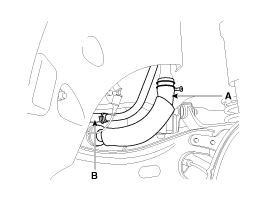
Disconnect the fuel filler hose (A) and the ventilation hose (B).
|
| 11. |
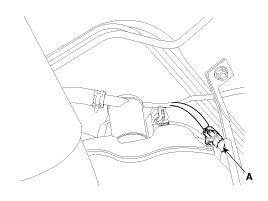
Disconnect thd canister close valve connector (A).
|
| 12. |
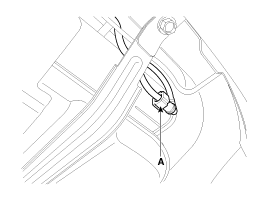
Disconnect the vapor tube quick-connector (A).
|
| 13. |
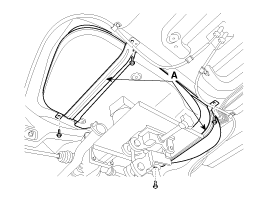
Remove the fuel tank from the vehicle after removing the fuel tank band (A).
|

| Installation |
| 1. |
Install in the reverse order of removal.
|
 Repair procedures
Fuel Pressure Test (Low pressure system)
1.
Release the residual pressure in fuel line.
(Refer to Fuel Delivery System - "Release Residual Pressure in Fuel Line")
When rem ...
 Fuel Pump Repair procedures
Removal
1.
Release the residual pressure in fuel line.
(Refer to Fuel Delivery System - "Release Residual Pressure in Fuel Line")
2.
Remove the rear seat.
(Refer to Body - “Seat�)
...
Other information:
Hyundai Tucson (LM) 2010-2015 Service Manual: Pressure Sensor Repair procedures
Inspection
If you have trouble code related to the pressure sensor check pressure sensor according to the inspection process.
Pressure Sensor Inspection Procedure
Measure the resistance of pressure sensor
1.
Turn ignition switch OFF.
2.
Disconnect the pressure ...
Hyundai Tucson (LM) 2010-2015 Service Manual: Underdrive Brake Control Solenoid Valve(UD/B_VFS) Repair procedures
Inspection
1.
Turn ignition switch OFF.
2.
Disconnect the solenoid valve connector.
3.
Measure resistance between sensor signal terminal and sensor ground terminal.
4.
Check that the resistance is within the specification.
Removal
Replacing an on/off soleno ...
