
Hyundai Tucson: Engine Control System / Intake Air Temperature Sensor (IATS) Repair procedures
Hyundai Tucson (LM) 2010-2015 Service Manual / Engine Control / Fuel System / Engine Control System / Intake Air Temperature Sensor (IATS) Repair procedures
| Inspection |
| 1. |
Turn the ignition switch OFF. |
| 2. |
Disconnect the IATS connector. |
| 3. |
Measure resistance between the IATS terminals 3 and 4. |
| 4. |
Check that the resistance is within the specification.
|
| Removal |
| 1. |
Turn the ignition switch OFF and disconnect the battery negative (-) cable. |
| 2. |
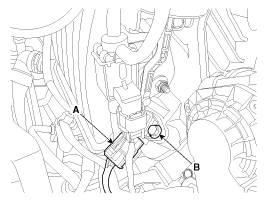
Disconnect the manifold absolute pressure sensor connector (A). |
| 3. |
Remove the installation bolt (B), and then remove the sensor from the surge tank.
|
| Installation |
|

|
| 1. |
Install in the reverse order of removal.
|
 Intake Air Temperature Sensor (IATS) Schematic Diagrams
Circuit Diagram
(M/T)
(A/T)
...
 Engine Coolant Temperature Sensor (ECTS) Description and Operation
Description
Engine Coolant Temperature Sensor (ECTS) is located in the
engine coolant passage of the cylinder head for detecting the engine
coolant temperature. The ECTS uses a thermistor that ...
Other information:
Hyundai Tucson (LM) 2010-2015 Service Manual: Repair procedures
Removal
1.
Disconnect the negative (-) battery terminal.
2.
Remove the steering column upper and lower shrouds (A) after removing 3 screws.
[LHD]
[RHD]
Take care not to damage and scratch the shrouds and its related parts.
Take care not to damage the hook when remov ...
Hyundai Tucson (LM) 2010-2015 Service Manual: Power Window Switch Repair procedures
Inspection
Main Power Window Switch Inspection
1.
Disconnect the negative (-) battery terminal.
2.
Remove the front door trim and power window switch.
(Refer to the BD group - "Front door")
3.
Check for continuity between the terminals in each switch
position according to the table. ...
© 2010-2026 www.htmanual.net
