
Hyundai Tucson: Rear Suspension System / Rear Lower Arm Repair procedures
| Replacement |
| 1. |
Remove the rear wheel & tire.
|

| 2. |
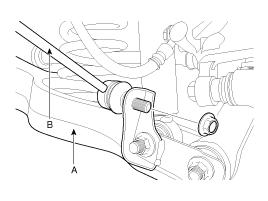
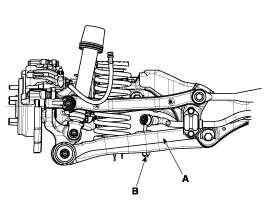
Loosen the nut and then remove the rear stabilizer link (B) with the rear lower arm (A).
[4WD]
[2WD]
|
| 3. |
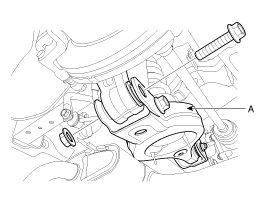
Loosen the bolt & nut and then remove the rear lower arm (A) with the rear axle.
|
| 4. |
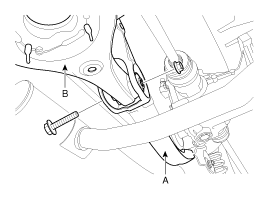
Loosen the bolt & nut and then remove the rear lower arm (B) with the sub frame (A).
|
| 5. |
Installation is the reverse of removal. |
| Inspection |
| 1. |
Check the bushing for wear and deterioration. |
| 2. |
Check the rear lower arm for deformation. |
| 3. |
Check the coil spring and spring pad for deterioration and deformation. |
| 4. |
Check for all bolts and nut. |
 Rear Upper Arm Repair procedures
Replacement
1.
Remove the rear wheel & tire.
Tightening torque :
88.3 ~ 107.9N.m (9.0 ~ 11.0kgf.m, 65.1 ~ 79.6lb-ft)
Be careful not to damage to the hub bolts when ...
 Rear Stabilizer Bar Repair procedures
Replacement
1.
Remove the rear wheel & tire.
Tightening torque :
88.3 ~ 107.9N.m (9.0 ~ 11.0kgf.m, 65.1 ~ 79.6lb-ft)
Be careful not to damage to the hub bolts when ...
Other information:
Hyundai Tucson (LM) 2010-2015 Owners Manual: Seat Belt – Passenger’s 3-point system with combination locking retractor
This type of seat belt combines the features of both an emergency locking retractor
seat belt and an automatic locking retractor seat belt.
Combination retractor type seat belts are installed in the rear seat positions
to help accommodate the installation of child restraint systems. Although a ...
Hyundai Tucson (LM) 2010-2015 Service Manual: Filler-Neck Assembly Repair procedures
Removal
1.
Remove the rear-LH wheel, tire, and the inner wheel house.
2.
Disconnect the fuel filler hose (A) and the ventilation hose (B).
3.
Open the fuel filler door and unfasten the filler-neck assembly mounting screw (A).
4.
Remove the filler-neck assembly from the vehicle after ...
