
Hyundai Tucson: ESC(Electronic stability system) System / Yaw-rate and G Sensor Description and Operation
| Description |
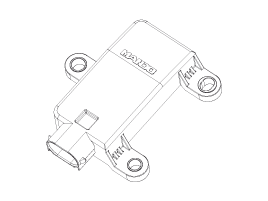
| Description | Specification | Remarks |
| Operating voltage | 10 ~ 16V |
| Output signal | CAN Interface |
| Operating temperature | -40 ~ 85°C (-40 ~ 185°F) |
| Yaw-rate sensor | Operating range | -75 ~ 75°/sec |
| Frequency response | 15 ~ 45Hz |
| Lateral G sensor | Operating range | -14.75 ~ 14.75m/sx |
| Frequency response | 50Hz ± 60% |
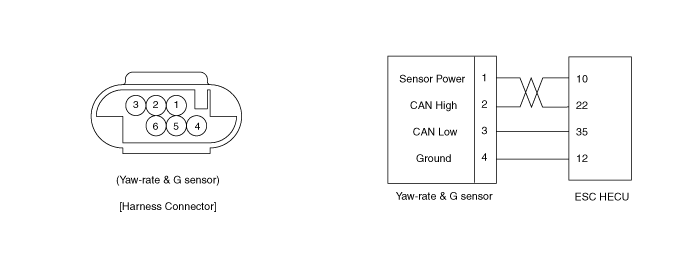
 ESC Control Unit Repair procedures
Removal
1.
Turn the ignition switch OFF.
2.
Disconnect the brake tubes from the HECU by unlocking the nuts counterclockwise with a spanner.
Tightening torque :
ABS : 12.7 ~ 16.7N.m(1.3 ~ 1 ...
 Yaw-rate and G Sensor Repair procedures
Removal
1.
Turn ignition switch OFF and disconnect the negative (-) battery cable.
2.
Remove the floor console.
3.
Disconnect the yaw rate & lateral & Longitudinal G sensor connect ...
Other information:
Hyundai Tucson (LM) 2010-2015 Service Manual: AUX(Auxiliary) Jack Description and Operation
Description
The AUX, iPod and USB JACK on the center console is for
customers who like to listen to external portable music players like the
MP3, iPod, earphone, USB memory stick, CD player and etc., through the
vehicle's sound system when it is linked to this jack. The customer has
this ...
Hyundai Tucson (LM) 2010-2015 Owners Manual: Seat warmers
Seat warmers are provided to warm the seats during cold weather.
WARNING
The seat warmers can cause a SERIOUS BURN, even at low temperatures and especially
if used for long periods of time. Passengers must be able to feel if the seat is
becoming too warm so they can turn it off, if needed. Peo ...
